
A Conversation with Lanie Doerr: Farmers Are People
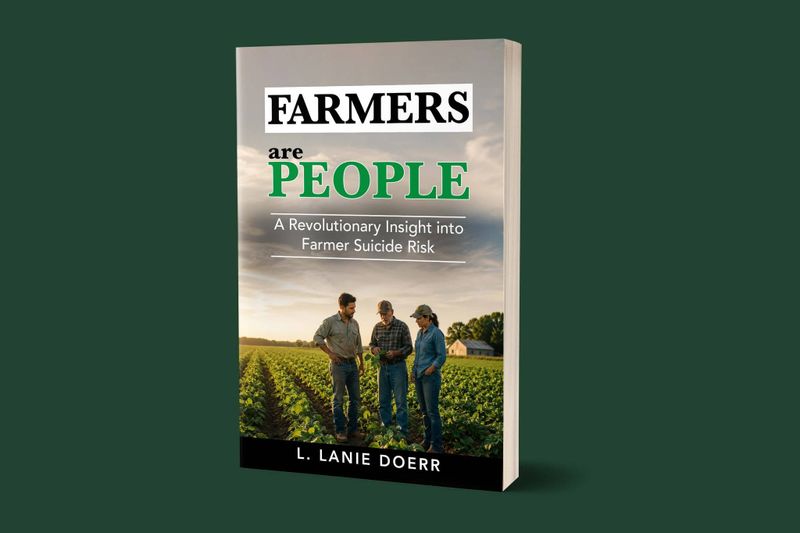
In this interview, we discuss "Farmers are People" by Lanie Doerr, LPC with the locally-based author and therapist.
September 28, 2026
Interview by Chari Bauman, Coffey County Chamber of Commerce
This transcript has been lightly edited for grammar and clarity.
Chari Bauman: Hi, this is Chari Bauman with the Coffey County Chamber of Commerce, and I’ve got Lanie Doerr here with us for our Ad Astra morning segment today. Lanie, please tell us a little about yourself.
Lanie Doerr: My name is Lanie Doerr. I’m a licensed professional counselor, and I farmed for a living for about 12 years. I grew wheat and mostly dryland crops down in the Oklahoma Panhandle. My home county is the epicenter of the Dust Bowl, and that’s where I farmed.
Now I’m in private practice as a counselor. I work with individuals, couples, families, and children, so pretty much everybody.
Chari Bauman: You’re based here in Coffey County, and you offer a lot of remote sessions?
Lanie Doerr: Yes, I do a lot of online sessions, but I also have the ability to see people in person in Gridley. If somebody really wants to meet in person, I can appreciate that. I like being in person, too.
Chari Bauman: You recently published your first book. Is that correct?
Lanie Doerr: Yes, I did.
Chari Bauman: Tell us a little more about that book.
Lanie Doerr: My book is called Farmers Are People, and the subtitle is A Revolutionary Insight into Farmer Suicide Risk.
Many people are already aware that farmer suicide is a big problem. What I address in my book is that we need to describe the problem more accurately so we can generate better solutions.
I felt strongly, and still do, that when we describe farmer suicide risk as based exclusively on the stressors and pressures of farming, that’s not a very accurate description. Those pressures are the start of a domino effect that can end in feelings of hopelessness, relationship problems, or feeling like a burden on your family. That’s where the suicide risk comes in. We need that better description so we can be more helpful.
Chari Bauman: Who would you recommend your new book to?
Lanie Doerr: Therapists seem to like it. I’ve gotten some good feedback from other therapists, social workers, counselors, and psychologists.
I’d also recommend it to farm families, extension agents, and anybody who works with farmers and ranchers. I know bankers have been concerned because the crisis is getting pretty deep right now.
It’s a quick read. It only takes most people about an hour, and I think it would be useful.
Chari Bauman: I love that. What was the process like, writing a book for the first time?
Lanie Doerr: It was a lot different than I thought it would be because I had been developing some of these ideas for a long time. I started researching this topic before I even went to graduate school to become a therapist.
I would read research and work with clients, including farmers, and I kept feeling dissatisfied with most of what we tell the farming public about what’s going on with them and what they need to do. I kept thinking, “There’s more. I think we can do a better job.” That’s what eventually led to my book.
Chari Bauman: What was your experience like when you were farming?
Lanie Doerr: My home county, where I was farming, tends to be a feast-or-famine type of country for crops. We were all dryland farming, so we hoped to raise a good crop maybe two out of every five years. That was our hope, and it lends itself to a lot of despair.
The realities of modern agriculture are pretty dark. Land prices have skyrocketed to where they don’t even really make sense anymore. Input costs are way up, and it’s hard to find hired help.
There are a lot of really intense problems that I don’t think we’re about to get fixed. I don’t think we can say that if people can just hang on, we’re going to solve these problems and reduce that stress in their lives. I would love that. I think that would be a wonderful solution.
But since we can’t do that right now, I want to work on how we can help people from the inside to be more resilient to the realities of their world. We need to recognize what the problems really are and address them specifically, including those real risk factors for depression and suicide.
Chari Bauman: Where can people find a copy of your book?
Lanie Doerr: My book is for sale on Amazon. You can read it on your Kindle or buy a paperback. I would love to hear your feedback, and a review would be wonderful, too.
Chari Bauman: If there are any farmers listening right now, do you have any words of advice for them?
Lanie Doerr: Absolutely. I already know you’re tough.
I watched my dad do things all through my childhood. When it’s your dad, you think he’s a superhero. Then you get a little older and realize there are a lot of people who are super tough. They’re out there every day doing the work and bearing the emotional burdens as well.
I already know you’re tough. If you want to take that next step and show me how courageous you can really be, and you’re in a place where you’re having thoughts of suicide, go ahead and make that call. Dial 988. Let somebody know that you need a little bit of help.
I already know you have the courage. I just think you use it for everything but yourself.
Chari Bauman: I love that. That’s very good advice. Thank you so much for joining us today, Lanie. Hopefully, we’ll get to hear more about future books as you continue in your career.
Lanie Doerr: Thanks.
Coffey County Chamber of Commerce
305 Neosho St, Suite A,
Burlington, KS 66839
620-490-0701
www.coffeycochamber.com